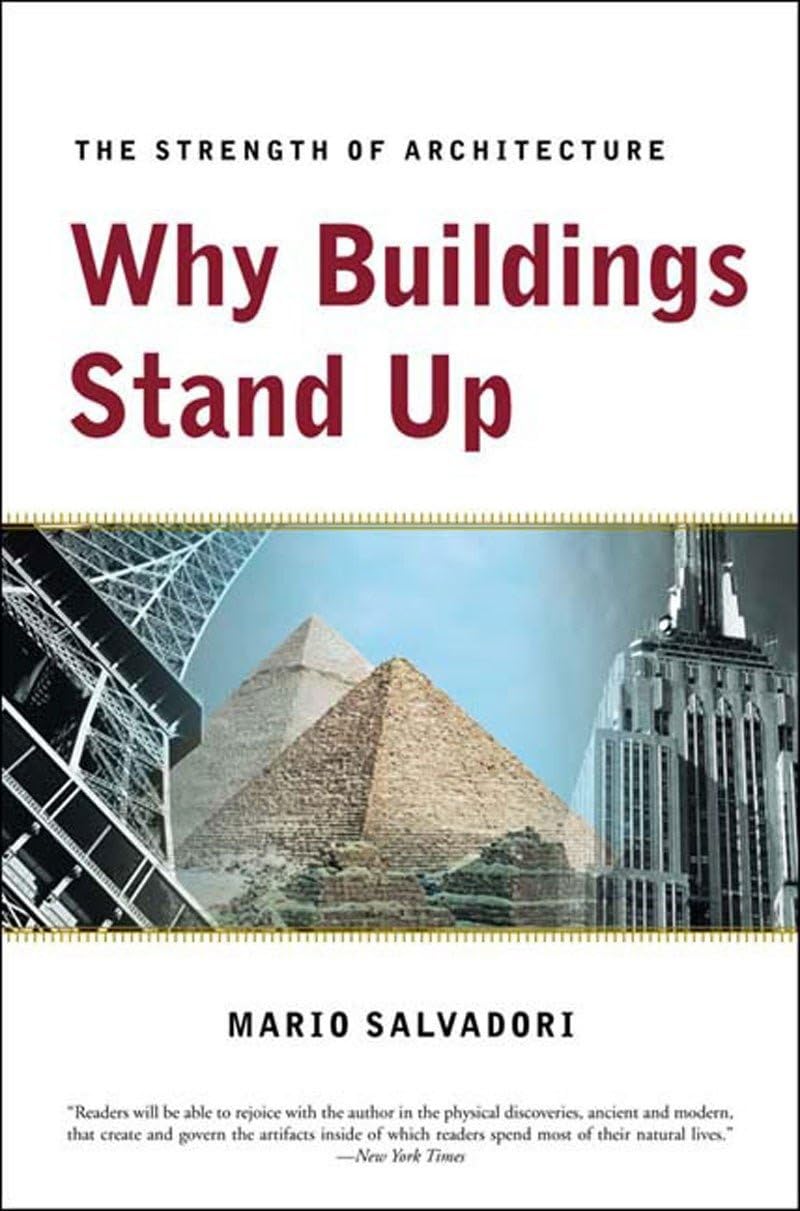
Why buildings stand up: The strength of Architecture, by Mario Salvadori.
I started this book a long time ago. Because it needs a large view format, the eBook I have is not good to read in a small Kindle, and using the large one in bed is more complicated (I tend to fall asleep and drop devices to the floor).
But after finishing Exactly, I wanted to follow up on similar subjects and decided to complete the reading. I am glad that I did it.
When I was studying electrical engineering there was this concept that a well rounded engineer should be able to do more things than in the specialty. In my case we had to take several year long courses on buildings and materials concepts, for which I had very little interest. I wanted to build computers, maybe robots, and I was lectured in how to calculate I beams. Years after the fact I am closer to accept the idea (I rejected it at the time), but the timing was unfortunate. By the time we reached some computer concepts (we never even talk about robots), I already had a successful business and my interest in the degree was diminished.
In my head I still had some of the knowledge gained at that time. Some concepts about efforts, forces in a static structure, things like that. Vague ideas on how to calculate them, which I could sharpen with some hours on a book for a real project, but I haven't any civil engineering client in a long time. Mostly, the subjects are still a joke with my friends from that era.
This book revamped those concepts in my head. The author like buildings, and he explain clearly how and why they work. How they evolved, and why we find them interesting, or beautiful. Why they look solid, and how our cultural concept of beauty changed with time.
It also describes, without going into formulas, which are the intuitions to calculate individual components, where is the effort, what can break and why it breaks, or not.
It has hand drawn illustrations of buildings and explanations of some details, which I found very interesting and helped me remember that although I dreaded those classes, some of the things were actually interesting. They even made me think about drawing again, something that I have not done for decades now.
I am recommending this book to my engineering oriented friends.